
Why Is Medicai the Best for Connects with EHRs?
Many hospitals still juggle separate logins and file transfers just to move a single CT series into their EHR. The extra clicks and duplicate entries drain staff time and raise the chance of missing prior studies during rounds.
By the final section you will know which integration points Medicai actually automates, how its cloud PACS and DICOM gateway fit inside existing EHR workflows, and whether the pricing tiers match the volume of studies your team handles each week.
What Is Medicai?
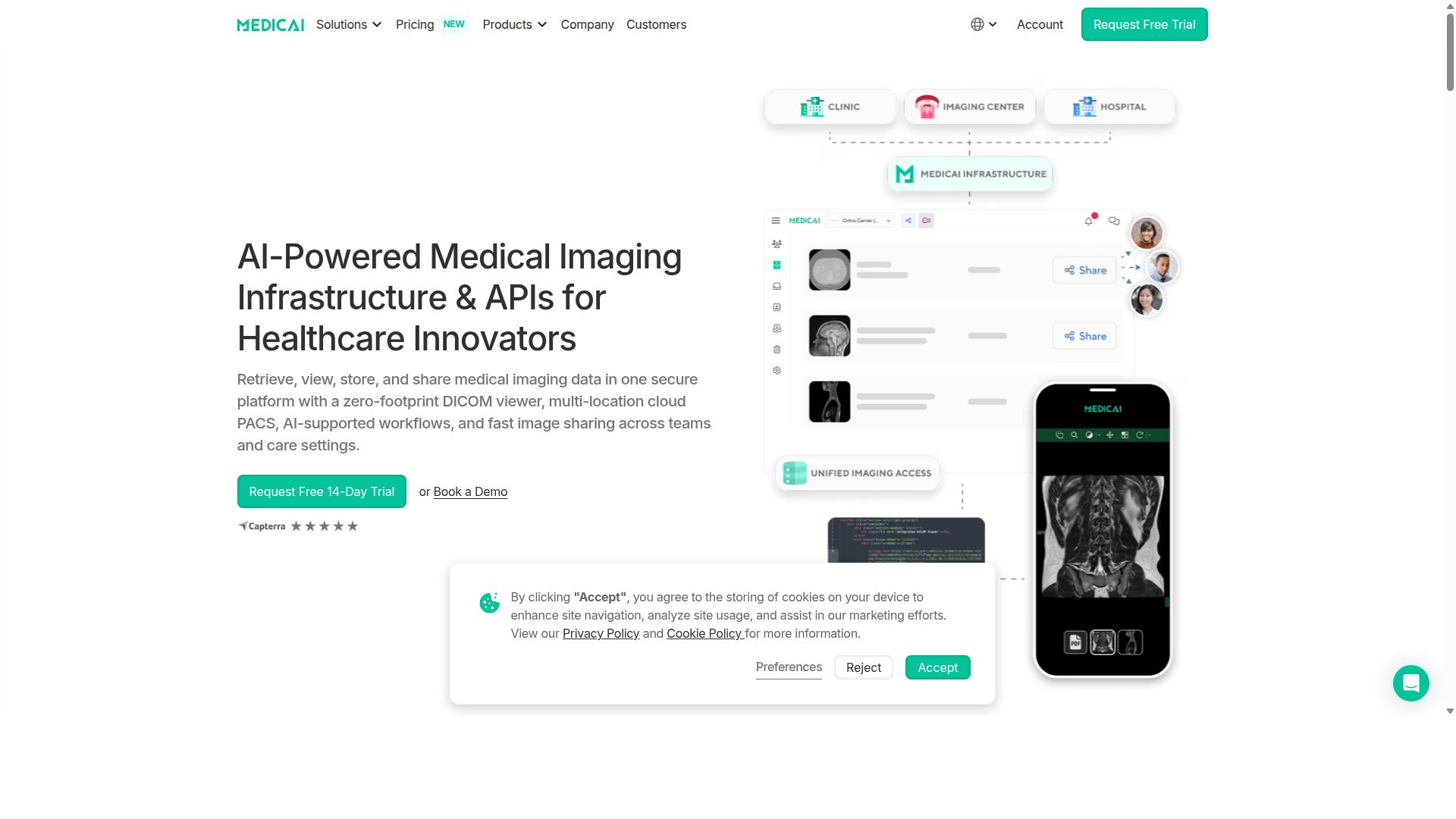
Medicai operates as a zero-footprint, cloud-based medical imaging platform that retrieves, stores, and shares DICOM studies through a single HIPAA- and GDPR-compliant interface. Healthcare providers access imaging data directly through web browsers without installing local software. The platform supports upload, viewing, and exchange of studies across different care settings.
Cloud-based infrastructure enables medical teams to work from any location while maintaining data security standards. Research suggests this approach reduces technical barriers that often slow down clinical workflows. The platform processes over one million studies annually through its FDA and CE-cleared viewer. For the next step, read our overview of CLIA Full Form in Medical Billing Explained.
Healthcare organizations use the platform to connect medical imaging systems with existing electronic health record systems. The vendor-neutral archive stores imaging data from multiple sources in one location. This setup supports interoperability requirements that many medical facilities need for regulatory compliance.
Medical professionals access patient imaging through the same interface that handles DICOM files and patient records. The platform supports multi-location practices by providing consistent access across different facilities. Imaging Infrastructure as a Service allows organizations to modernize their imaging workflows without managing separate hardware systems.
Why Medicai Excels at EHR Connectivity
Medicai connects directly to existing EHR systems through an API-first, HL7 FHIR-compliant architecture that eliminates duplicate data entry and maintains a single source of truth across the patient record. This approach supports seamless data exchange between systems and preserves complete patient histories without manual updates.
Integration methods include RESTful API endpoints that handle imaging orders and results. HL7 FHIR resources structure clinical data for consistent exchange across care teams.
Automated ingestion reduces manual entry and preserves longitudinal patient views by updating records as studies complete. This design supports radiology workflow efficiency and clinical decision support without interrupting existing processes.
Key Features and What Makes Medicai Stand Out
Three feature clusters, connect and retrieve, store and manage, and access, visualize, collaborate, work together to create an end-to-end imaging workflow that improves diagnostic accuracy and physician productivity.
Each cluster targets one stage of radiology workflow so data moves cleanly from modality to interpretation. The first stage pulls external studies into the system. The second stage holds those studies in a secure, scalable archive. The third stage lets clinicians review, annotate, and share results without leaving the platform.
Because the three clusters share the same API-first architecture, healthcare IT teams avoid building separate bridges for each step. The result is fewer manual transfers and fewer chances for lost or duplicated files.
CONNECT & RETRIEVE: Medical Imaging Uploader, DICOM Gateway
The Medical Imaging Uploader and DICOM Gateway pull studies from any modality or legacy PACS via secure DICOM and REST endpoints.
Staff simply insert a CD or USB drive, or allow a modality to send directly. The uploader reads the media, extracts the DICOM headers, and matches patient data to the correct record. No separate import step is required.
Encrypted transmission follows HIPAA and GDPR standards, and the same pathway handles more than 50M yearly API transactions. Automatic validation flags corrupted or incomplete files before they reach the archive.
Because the service supports both legacy media and live modality feeds, clinics avoid buying new hardware. The workflow also reduces typing errors by pulling identifiers straight from the DICOM tags.
STORE & MANAGE: Cloud PACS, Medical Image Exchange, Patient Case Management
The Cloud PACS and Vendor Neutral Archive store 1.7M+ studies today while offering unlimited user accounts and role-based access controls that scale from single-site clinics to multi-location health systems.
Automated backup policies copy every study to geographically separate regions. If one data center fails, the second copy restores service within minutes, keeping regulatory compliance intact.
Medical Image Exchange moves studies between facilities without burning discs or mailing hard drives. A clinician at one site can request images from another site, and the exchange layer handles routing and audit logs.
Patient Case Management links each imaging study to structured reports and clinical notes. The combined record gives physicians a longitudinal view of patient data, which supports clinical decision support and reduces repeated scans.
ACCESS, VISUALIZE, COLLABORATE: Doctor Imaging Portal, Patient Imaging Portal
The Doctor Imaging Portal and Patient Imaging Portal deliver 300k+ DICOM visualizations each year, embedding AI overlays and structured reporting tools directly in the browser for instant collaboration.
Real-time synchronization keeps every user on the same version of the study. When a radiologist adds an annotation or measurement, referring doctors see the update immediately, cutting phone calls and emails.
AI-assisted tools inside the viewer perform measurements and highlight suspicious regions. Radiologists stay in one workspace to generate, edit, and electronically sign structured reports without switching applications.
Patients log into their portal to view images and reports on any device. Secure sharing links let external specialists join a case discussion, supporting tumor boards and second-opinion workflows across borders.
Pricing and Plans
Medicai offers transparent monthly subscriptions that scale storage and connected locations with organizational growth.
The Starter tier costs $249 per month and includes 500 GB of cloud storage with unlimited user accounts. This entry-level plan works well for small teams that need basic cloud access without external connections.
The Standard tier is priced at $749 per month and provides 2 TB of storage plus one connected location. Organizations that require PACS connectivity can choose this plan to link their existing imaging systems.
Monthly billing removes long-term lock-ins, so teams can adjust plans as their needs change. Enterprise customers receive custom pricing that supports multiple connected locations and larger storage volumes.
A 14-day trial of the Starter plan features is available without requiring a credit card. Yearly billing offers 15 percent savings compared to monthly rates for both Starter and Standard tiers.
The one-time DICOM Gateway Setup fee of $1,000 applies per location. Enterprise customers may also explore per-study pricing models that align costs with actual usage volumes.
Trust Signals
Compliance certifications, third-party partnerships, and usage metrics collectively verify Medicai's commitment to patient data protection.
HIPAA compliance ensures protected health information meets strict federal standards across all exchanges. GDPR compliance guarantees that data handling in the European Union follows established privacy regulations.
FDA clearance and CE marking confirm that Medicai meets medical device safety requirements before processing any patient studies. These clearances demonstrate regulatory acceptance across multiple jurisdictions.
Over 1 million studies are processed annually through the platform. This volume reflects consistent adoption by healthcare organizations that require reliable EHR integration capabilities.
Partnerships with Microsoft Azure, Amazon AWS, and New Relic provide the infrastructure foundation for secure data transmission. These alliances support encrypted connections between medical imaging systems and existing EHR platforms.
Additional technology collaborations with MD.ai, OHIF, and MedDream expand DICOM connectivity options. Integration with FlexView and Meditice strengthens PACS connectivity across different vendor environments.
Healthcare providers gain from these established relationships when implementing HL7 FHIR standards for structured data exchange. The combination of certifications and infrastructure partnerships creates the foundation for safe, scalable medical imaging workflows.
Who Should Use Medicai
Hospitals, imaging centers, and specialty practices that need vendor-neutral, cloud-based imaging connectivity without heavy IT overhead are ideal candidates.
Orthopedics and neurology departments benefit from this platform when they require consistent access to patient imaging across multiple locations.
Oncology and radiology teams use Medicai to maintain structured patient records that support tumor boards and clinical trials.
Cardiology and ophthalmology practices gain from integrated imaging workflows that reduce manual entry and support real-time synchronization.
Ob-gyn and pulmonology specialists appreciate the ability to share imaging data with referring physicians through secure channels.
Dentistry and gastroenterology clinics find value in the platform when they need to connect with external imaging providers without additional infrastructure.
Virtual care providers and telemedicine platforms also adopt Medicai when they require reliable imaging connectivity for their patient populations.
Teleradiology services, personal injury lawyers, and medical education organizations round out the user base that relies on this connectivity solution.
Patients access their imaging through the Patient Portal, which extends the platform value beyond clinical settings into individual care management.
Final Verdict
For organizations seeking a secure, API-first imaging platform that integrates with existing EHRs at predictable monthly cost, Medicai provides a compelling solution.
Its architecture supports HL7 FHIR and DICOM standards, enabling seamless data exchange across multiple systems. The platform maintains HIPAA compliance through encrypted transmission and role-based access controls.
Medical imaging teams benefit from automated ingestion that reduces manual entry and improves radiology workflow efficiency.
Healthcare IT departments gain PACS connectivity without the complexity of on-premise infrastructure. The vendor-neutral archive approach supports longitudinal patient view across different care settings.
Organizations can contact Medicai USA at 7901 4th St N, STE 300, St. Petersburg, FL, 33702 or call +1 (832) 220 1035. In Romania, the office is located at 53-55 N Filipescu, 5th Floor, Sector 2, Bucharest, 020961 with phone +40 316 305 875. Email inquiries are handled at sales@medicai.org.