
9 Best Tools for Automating WhatsApp Customer Support in 2026
Your support team is drowning in unanswered WhatsApp messages. Slow replies, missed follow-ups, and rising agent costs push most businesses to start comparing automation tools. Choosing the wrong one means paying for features you never use.
This article breaks down what to compare: features, pricing, and integration fit. You will get a clear look at nine tools, including Com.bot, an Official Meta Business Partner, plus a framework for picking the right option.
What to Look For in WhatsApp Customer Support Automation Tools
Evaluating WhatsApp customer support automation tools requires a clear framework to separate robust platforms from basic chatbots. The right solution must handle growing message volumes, connect with the systems a team already uses, and deliver measurable returns in the form of faster responses and lower operating costs.
Scale is the first pressure point. A tool that works for a small team can buckle when conversation volume climbs, especially during promotions or seasonal peaks. Message throughput and reliability matter as much as the feature list.
Integration determines whether automation actually saves time or simply adds another inbox to check. Tools that connect natively to a CRM or an omnichannel helpdesk keep customer history in one place and reduce manual data entry.
Finally, ROI should be judged qualitatively as well as quantitatively. Faster response times, more consistent answers, and higher agent productivity all point to a tool that earns its place. Buyers should also weigh how quickly a platform can be deployed and how much ongoing effort it demands.
With those three priorities in mind, the next step is a structured comparison across five practical criteria.
Key Features, Pricing, and Integration Factors to Compare
When comparing WhatsApp automation tools, prioritize five core areas: feature depth, pricing transparency, integration flexibility, scalability, and support quality. Each area reveals something different about how a platform will perform once real customer conversations begin.
- Features: Look for a visual chatbot builder that non-technical staff can use, plus natural language processing and intent recognition so the bot understands varied phrasing. Sentiment analysis helps flag frustrated customers for escalation, while automated ticket routing sends issues to the right team. Support for interactive message buttons, quick replies, and list messages keeps conversations efficient, and live chat handoff ensures a smooth transition to a human agent.
- Pricing: Understand whether the model charges per agent, per message, or per conversation. Per-agent pricing suits steady teams, while per-message pricing can escalate with high volumes. Watch for hidden fees around onboarding, extra channels, or message templates, and confirm what the WhatsApp Business API conversation costs add on top.
- Integrations: Check for native connections to CRMs such as Salesforce and helpdesks such as Zendesk. A strong WhatsApp CRM integration syncs contact records and conversation history automatically. Also verify access to the template message API for outbound notifications and confirm whether the provider is a recognized WhatsApp Business Solution Provider or Meta verified partner.
- Scalability: Ask about message throughput limits, uptime SLAs, and how the platform behaves during traffic spikes. A no-code automation platform should let teams add flows and channels without rebuilding everything from scratch.
- Support: Confirm whether 24/7 customer service is available for technical issues, and whether onboarding assistance is included. Reliable vendor support shortens the path from purchase to a working deployment.
Beyond these five areas, consider the conversational layer itself. A capable AI-powered virtual assistant should handle multilingual support and improve first contact resolution over time. These qualities feed directly into customer satisfaction CSAT and response time reduction.
Buyers should also weigh how transparent a vendor is about limits. Clear documentation on message throughput, template approval, and media handling prevents surprises later. Taken together, these criteria form a practical scorecard that any team can apply before committing to a platform.
1. Com.bot - Best Overall
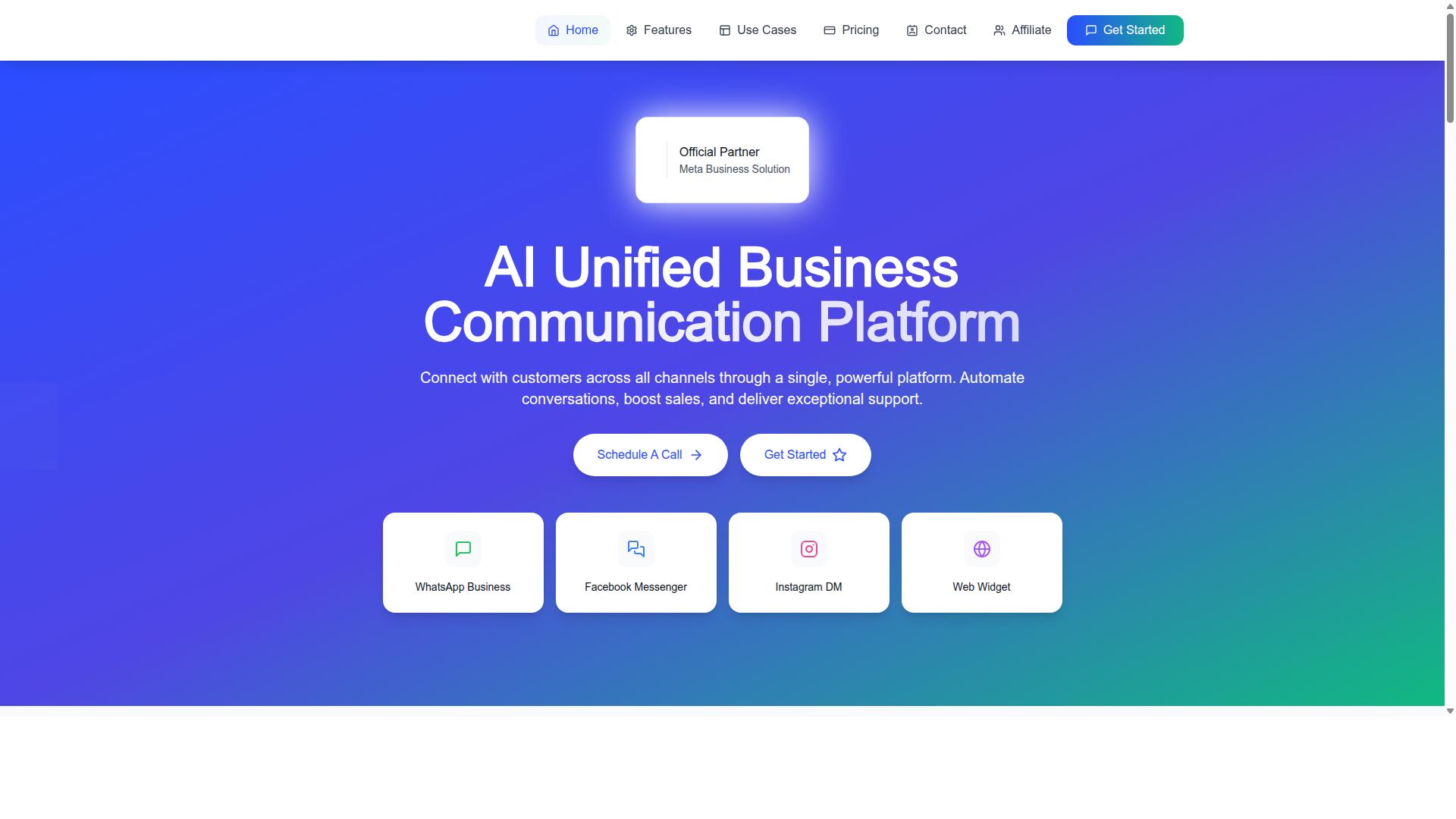
Com.bot earns the top spot for its comprehensive feature set and official Meta partnership, making it a reliable choice for businesses of all sizes. It combines a unified team inbox, a visual bot builder, and native payment collection in one platform, so support teams do not need to stitch together separate tools for messaging and transactions.
For companies evaluating WhatsApp customer support automation in 2026, that combination matters. Support, sales, and payments often live in different systems, which slows response times and creates gaps in the customer journey. Com.bot closes those gaps by keeping conversations and transactions on a single platform.
The platform is owned and managed by Com Bot AI Limited and serves a global customer base. Its official Meta Business Partner status and direct WhatsApp Business API integration give it a compliance advantage over unofficial workarounds, which is a key reason it leads this list.
Official Meta Partner with Unified Inbox, Bot Builder, and Native Payments
Com.bot's official Meta Business Partner status ensures compliance and early access to new WhatsApp features, while its unified inbox consolidates WhatsApp, Facebook Messenger, Instagram DM, and web widget into one interface. Agents handle every channel from a single screen, which supports an omnichannel helpdesk approach instead of channel-by-channel chaos.
The visual bot builder uses a drag-and-drop interface, so teams can launch smart chatbots without writing code. It functions as a no-code automation platform for building flows that handle common questions, qualify leads, and route conversations to the right agent. An automation builder with 1000+ integrations connects the platform to the rest of a company's stack.
Native payments let businesses collect payment inside WhatsApp conversations, which shortens the path from question to purchase. Bulk messaging, order updates, notifications, and payment collection round out the toolkit for teams that use WhatsApp as a revenue channel, not just a support line.
Adoption numbers back up the positioning:
- 23,000+ active customers use the platform
- 25M+ messages processed daily
- 100K+ bots created
Pricing is structured around three plans. Silver costs $149 per quarter, Gold costs $349 per quarter and is the recommended option, and Platinum costs $2500 per quarter. Add-ons include $10 per month per additional team member, so costs scale with the size of the support team rather than a flat enterprise fee.
Security is handled with end-to-end encryption, which matters for businesses handling order details, payment references, and personal data in chat. Team collaboration features with role-based access let managers control who can view conversations, issue refunds, or edit bot flows. For organizations that need more than messaging, the same company also offers Tasks.Bot for enterprise-grade task automations, Tickets.Bot for event ticketing, and Calendars.Bot for AI appointment booking.
2. Trengo
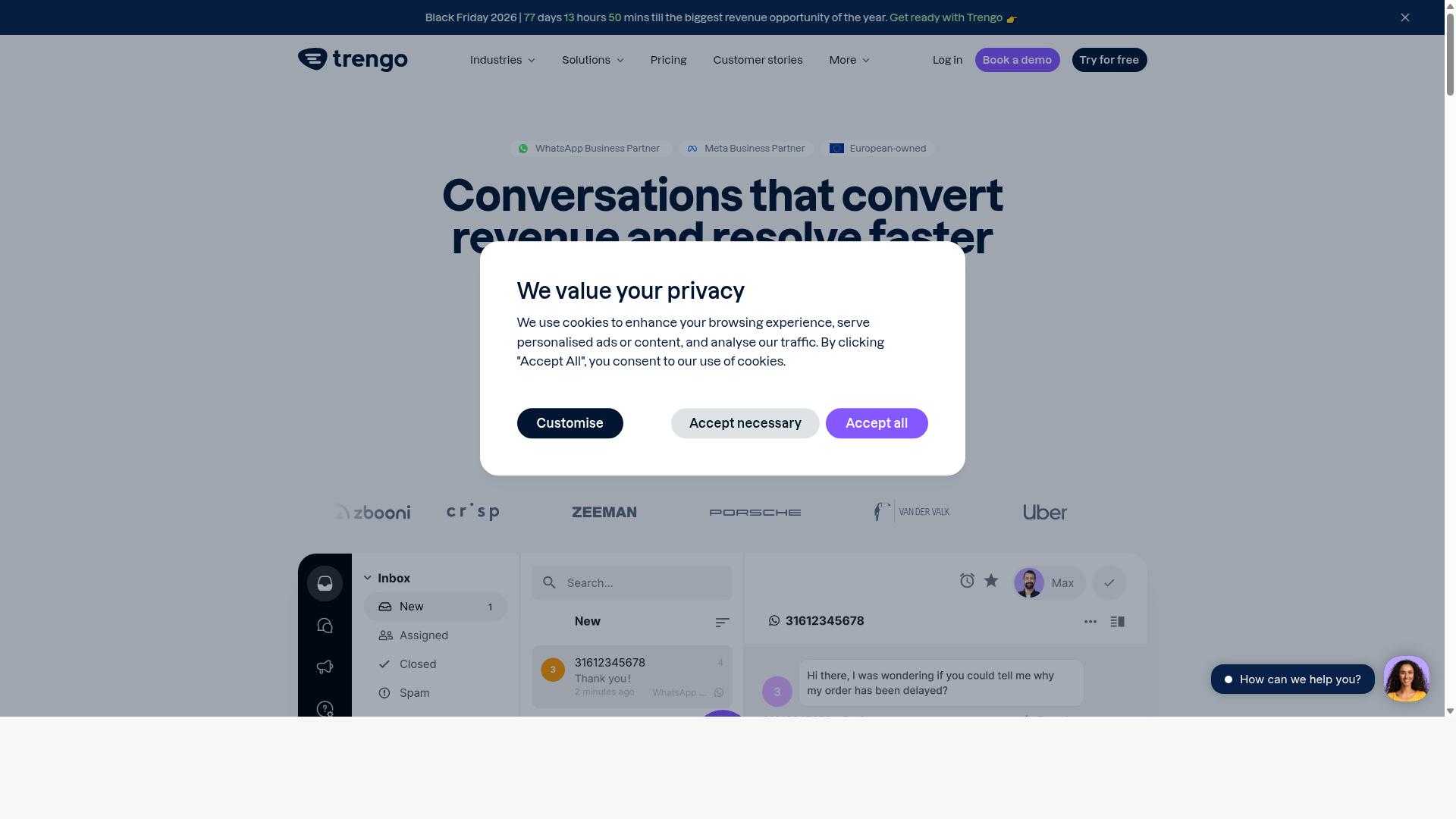
Trengo is a customer support platform mentioned in roundups of alternatives to WhatsApp automation tools.
Pricing for tools in this category typically starts around $19 per user per month on entry-level plans, with costs rising as you add seats, channels, or advanced automation. Exact figures vary by plan tier and billing cycle, so it is worth checking current rates directly before committing.
Trengo is generally positioned as an omnichannel helpdesk rather than a deep automation engine. Its strengths sit in inbox organization, collaboration, and straightforward workflow rules.
There are a few limitations to weigh before adopting it:
- Limited native payment options. Teams that want to collect payments or handle transactions inside WhatsApp conversations may need external tools or workarounds.
- Automation depth. Rule-based flows cover common scenarios, but businesses wanting advanced conversational AI, natural language processing, or intent recognition may find the native capabilities narrower than dedicated chatbot platforms.
- Scaling complexity. As agent counts and channel numbers grow, per-user pricing and workflow management can become harder to keep tidy.
For a small or mid-sized team that mainly needs a shared WhatsApp inbox with light automation, Trengo is a practical option. Businesses whose priority is 24/7 customer service driven by AI or complex WhatsApp CRM integration may want to evaluate tools built specifically around those needs.
3. Zoko
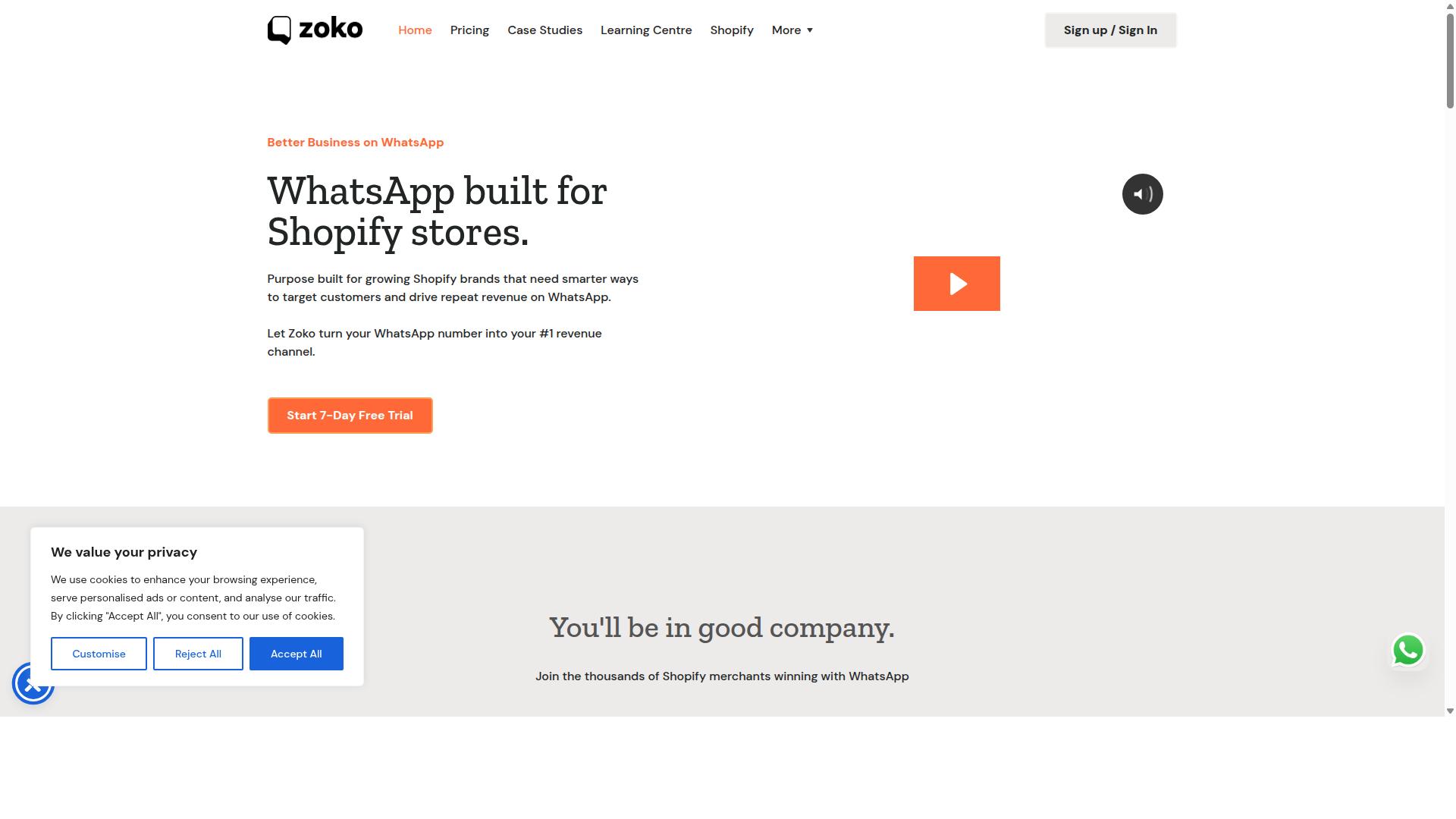
Zoko is a WhatsApp marketing tool listed among platforms that help businesses automate campaigns, manage customer conversations, and drive sales via the official WhatsApp Business API.
Below are the areas where Zoko tends to stand out for e-commerce teams evaluating customer support automation tools.
- Catalog management: Lets agents share product catalogs directly in chat so shoppers can browse items without leaving the conversation.
- Order tracking: Connects store order data to WhatsApp threads, so customers can check status and delivery updates in the same place they asked their question.
- Automated responses: Handles common queries such as order status, shipping timelines, and product availability without an agent stepping in.
For a small e-commerce team, these three capabilities cover much of the daily support load. Order status questions and product inquiries are among the most repetitive messages a store receives, and automating them frees agents for higher-value conversations.
Zoko's pricing model starts at around $29 per month according to publicly available information, which places it in the affordable range for small and mid-sized merchants. Pricing at this level typically suits businesses that want commerce features without enterprise-level contracts.
The target audience is clearly e-commerce businesses, especially Shopify merchants. A clothing brand fielding sizing questions, or a supplements store handling reorder requests, fits the profile Zoko is built for.
The main limitation is channel breadth. Zoko is WhatsApp-first, so teams that need a true omnichannel helpdesk spanning email, Instagram, and live chat may find it narrower than general-purpose platforms. Businesses with support volume spread across many channels should weigh that trade-off carefully.
For stores where WhatsApp is the primary sales and support channel, though, that focus is a strength rather than a constraint. Fewer channels means less configuration and a simpler agent experience.
4. DelightChat
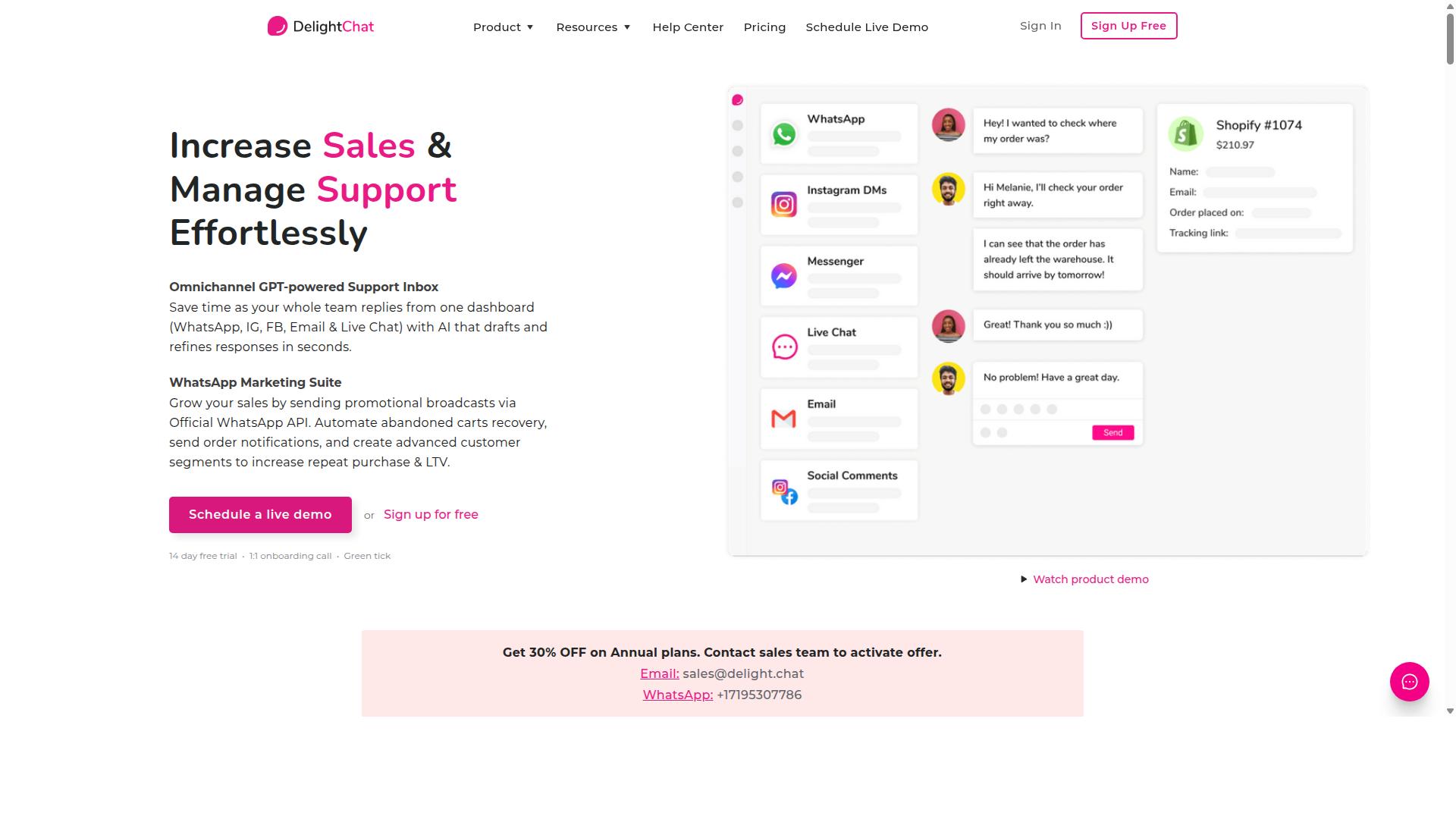
DelightChat is a WhatsApp-based customer support tool designed for e-commerce, offering a shared inbox and automation features. It sits in a practical middle ground for online sellers who need more structure than a basic WhatsApp Business app but do not want the overhead of an enterprise platform.
Its core pitch is straightforward: bring customer conversations from multiple channels into one place, then let automation handle the repetitive parts. For small stores juggling order questions and delivery updates, that combination can meaningfully reduce manual effort.
Below is a look at what the tool typically covers, along with pricing and scaling notes worth weighing before you commit.
Core Offerings: Team Inbox, Bot Automation, and Shopify Integration
DelightChat centers on a shared team inbox. Instead of one person owning the WhatsApp number, multiple agents can view and respond to conversations from a single dashboard. This matters for stores where the founder, a support hire, and a fulfillment lead all touch customer messages.
The platform also includes bot automation for common queries. Stores can set up flows that answer routine questions, collect order details, or route a conversation to the right person. This is the kind of no-code setup that keeps a small team from answering the same question fifty times a day.
Its Shopify integration is the piece that ties it together for e-commerce. Agents can typically see order history and status alongside the chat, which shortens the back-and-forth needed to resolve a delivery or return question. Rather than asking customers for an order number, the agent often has the context already.
Other features commonly associated with this category of tool include:
- Quick replies and saved responses for frequent questions
- Conversation assignment so agents know who owns which chat
- Basic reporting on response times and ticket volume
- Live chat handoff when a bot cannot resolve an issue
The combination points to a clear use case: an online store that wants customer support automation without hiring a developer or stitching together three separate tools.
Pricing and Scalability Considerations
DelightChat generally offers a free plan, which makes it easy to test before committing. Paid plans are commonly reported to start around $49 per month, though exact tiers and limits can change, so it is worth confirming current details on the vendor's site.
Scalability is where small stores should think ahead. A shared inbox and bot flows work well at low volume, but costs and complexity tend to rise as agent seats and conversation counts grow. If your support volume doubles during a sale season, check how the plan handles that spike.
Questions worth asking before you commit:
- How many agent seats does each tier include?
- Are there limits on bot conversations or automation runs?
- Does the Shopify integration stay in sync as your catalog changes?
- Can you export conversation history if you switch tools later?
For a small online store, the appeal is the balance of price and function. It is less suited to large teams that need deep omnichannel helpdesk features or advanced conversational AI, where heavier platforms tend to fit better.
If your support is mostly WhatsApp plus a storefront, and your team is small, DelightChat is a reasonable fit. If you expect rapid growth or need sophisticated routing and analytics, compare it against tools built for higher volume before deciding.
5. Interakt
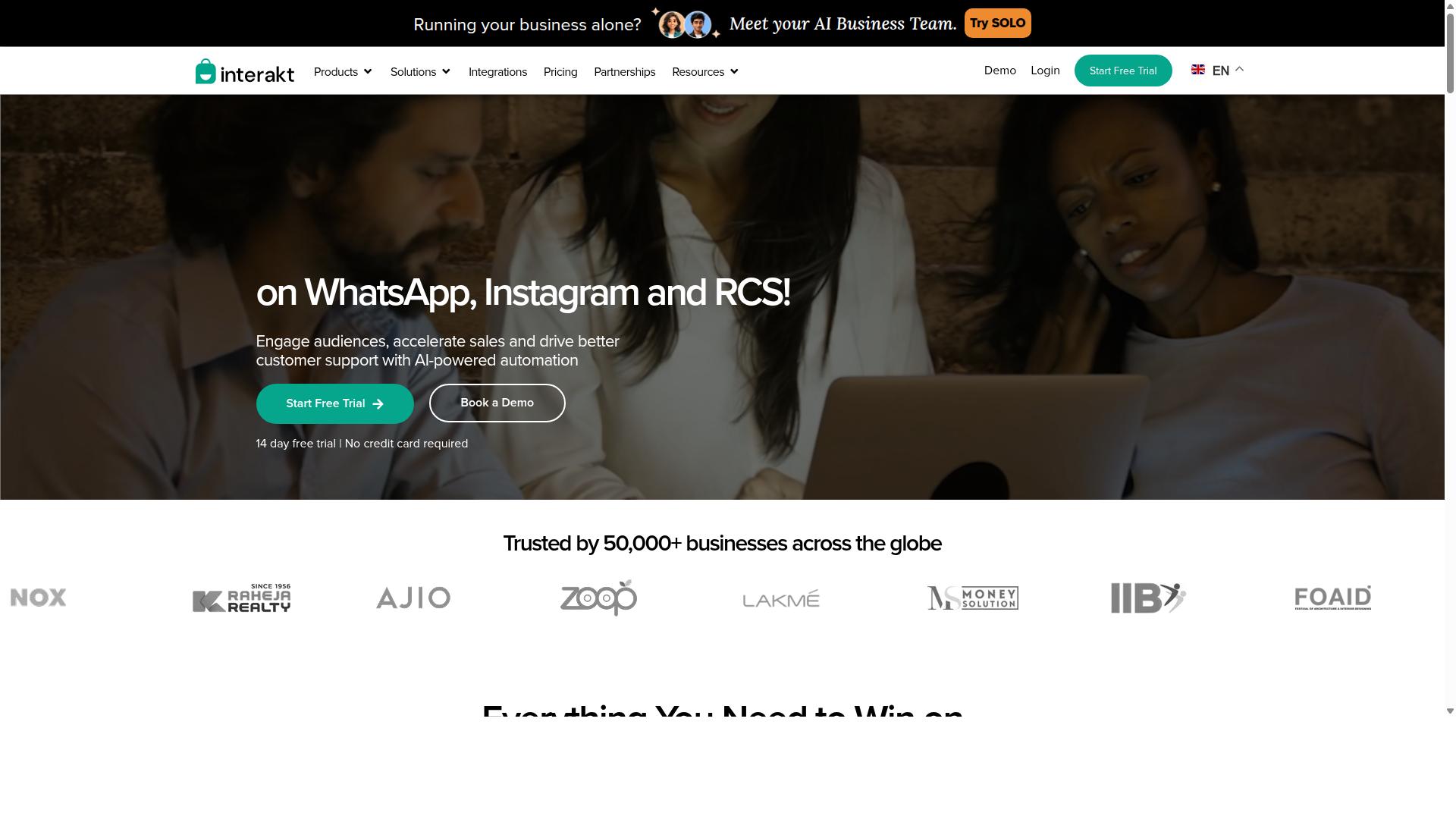
Interakt provides a WhatsApp Business API solution with a no-code bot builder and e-commerce integrations, aimed at small and medium businesses. It is built primarily as a WhatsApp marketing app for Shopify, though its automation layer covers sales and support conversations as well.
For teams that want to move quickly without engineering help, the no-code automation platform is the main draw. You can assemble flows, set auto-replies, and launch a chatbot without writing code.
Support automation in Interakt covers the basics well. Auto-replies handle common questions, chatbots manage repetitive queries, and AI agents can take on more open-ended conversations. A shared team inbox lets agents pick up where a bot leaves off, which supports a simple live chat handoff when a query needs a human.
Because Interakt was designed around commerce, several features target store owners directly:
- Abandoned cart reminders with checkout links
- COD double-confirmation to reduce return-to-origin orders
- Automated order updates sent over WhatsApp
- Bulk campaigns for promotions and announcements
- Instagram automation alongside WhatsApp
- Chat widget and WhatsApp Blue Tick application support
These additions make Interakt a practical fit for Shopify merchants who want marketing and support running through one channel. The trade-off is that its strengths lean heavily toward e-commerce workflows rather than general-purpose service desks.
Pricing is transparent and tiered. The Starter Plan is listed at $21 per month or $180 per year. The Growth Plan runs $41 per month or $296 annually, the Advanced Plan is $51 per month or $468 per year, and the Premier Plan sits at $99 per month or $839 per year. Additional WhatsApp conversation charges apply on top of the plan fee.
One limitation worth noting is the lack of native payment processing. Interakt can send checkout links and confirm orders, but it does not handle payments inside the chat itself. Businesses that want to collect payment directly in a WhatsApp thread will need a separate tool for that step.
Ease of use is where Interakt earns its place on this list. The interface is approachable for non-technical teams, setup follows a guided path, and the Shopify connection simplifies data flow between store and chat. For a small merchant testing WhatsApp support automation for the first time, that low barrier matters more than advanced customization.
Compare it against tools built for broader service operations. If your needs are mostly order-related messaging and campaigns, Interakt covers them cleanly. If you need deeper omnichannel helpdesk routing, sentiment analysis, or complex intent recognition across many languages, you may outgrow it.
6. SleekFlow
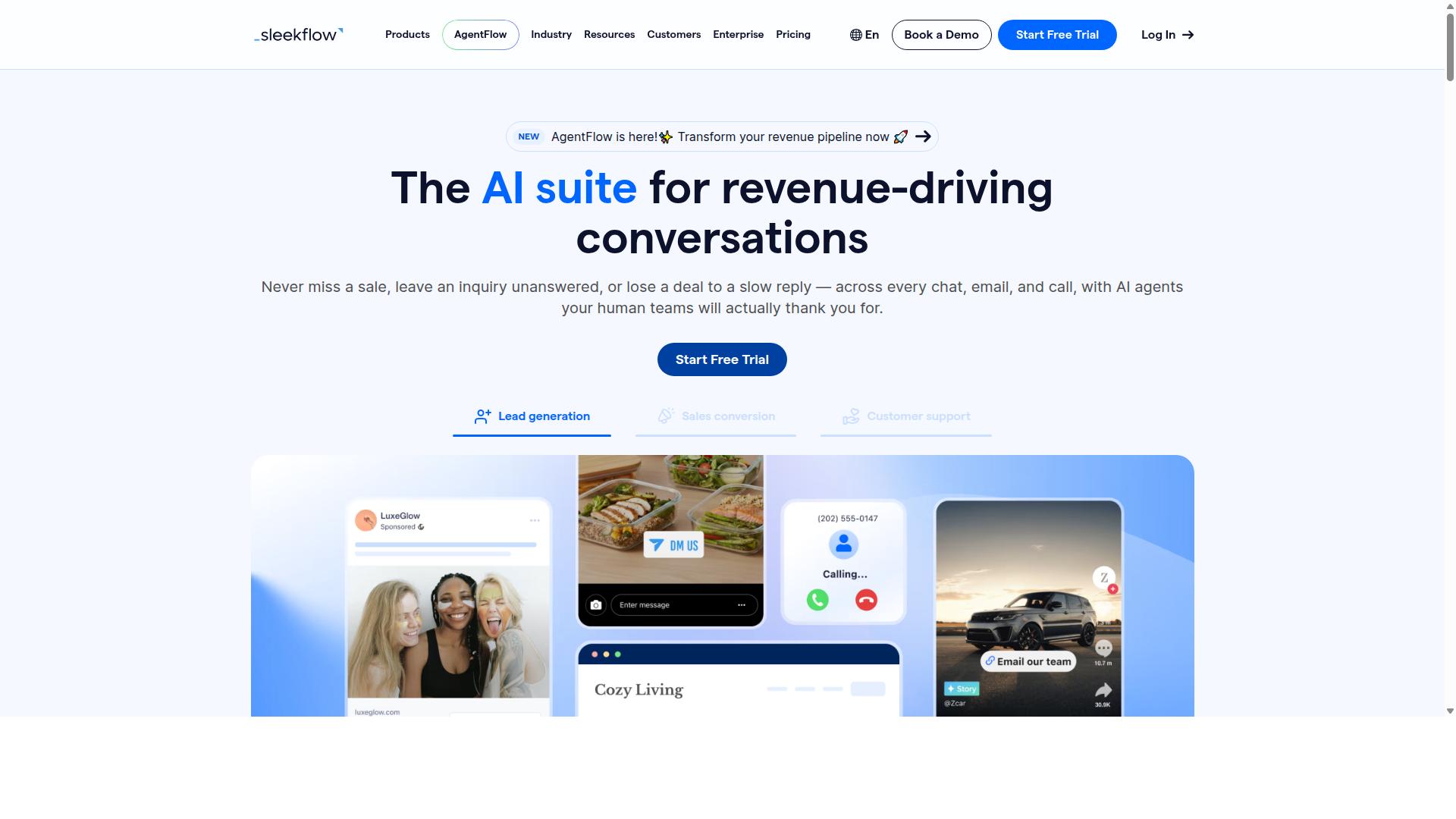
SleekFlow offers an omnichannel messaging platform with a focus on WhatsApp, supporting sales and support automation across multiple channels. It is an official WhatsApp Business Solution Provider, which means businesses can connect through the WhatsApp Business API without building their own integration layer.
The platform is built for teams that handle conversations across several touchpoints and want them consolidated into a single workspace. Instead of switching between apps, agents work from one omnichannel team inbox that pulls WhatsApp, Instagram, and Messenger chats together.
Beyond the inbox, SleekFlow includes a visual automation flow builder, broadcast campaigns, WhatsApp Flows, and AI-powered chatbots. It also ships with a unified CRM, ticketing, catalog and payment links, and chat and conversion analytics, so support and sales data sit in the same system.
Pricing follows a tiered model. The Startup plan is free, Pro costs $129 per month and includes 2,000 contacts, and Premium costs $349 per month with 12,000 contacts. Enterprise pricing is available on request, and WhatsApp messaging itself is billed separately with a markup.
SleekFlow positions itself for mid-market to enterprise businesses that want to consolidate multiple customer touchpoints into one dashboard. The company reports that over 7,000 enterprises across 70 countries use the platform.
The main trade-off is complexity. With flow building, CRM records, ticketing, and analytics all in one place, new users may need time to configure automation properly. Teams that only need basic WhatsApp replies could find the feature set heavier than necessary, while larger operations may see that depth as the reason to choose it.
7. Gupshup

Gupshup is a conversational messaging platform that provides robust APIs for WhatsApp and other channels, catering to enterprises and developers. It is listed among the WhatsApp marketing tools that help businesses automate campaigns, manage customer conversations, and drive sales through the official WhatsApp Business API.
The platform pairs WhatsApp messaging services with smart SMS campaigns and alerts, which makes it a fit for teams that want one vendor across multiple messaging channels. For support teams, that combination can simplify how notifications and follow-ups reach customers.
Gupshup's strengths tend to cluster in three areas:
- Advanced AI capabilities for handling conversational flows at scale
- High-volume messaging suited to large campaigns and busy support queues
- Developer-friendly APIs that let engineering teams build custom integrations
That API-first design is a real advantage for organizations with in-house development resources. It also shapes who gets the most value from the tool.
Pricing is not published publicly. Gupshup works on custom quotes, and costs are often higher for enterprise deployments with heavy messaging volumes or complex requirements. Buyers should request a tailored estimate based on their expected conversation load.
The trade-off is complexity. A platform built around APIs and developer tooling can be harder for non-technical users to configure without support, especially compared to drag-and-drop chatbot builders. Teams without engineering help may need to budget extra time for setup.
Gupshup also has global reach, which matters for businesses serving customers across regions and languages. Public sources do not specify a target audience or price points, so evaluate fit against your own volume, technical capacity, and channel mix before committing.
8. Wati
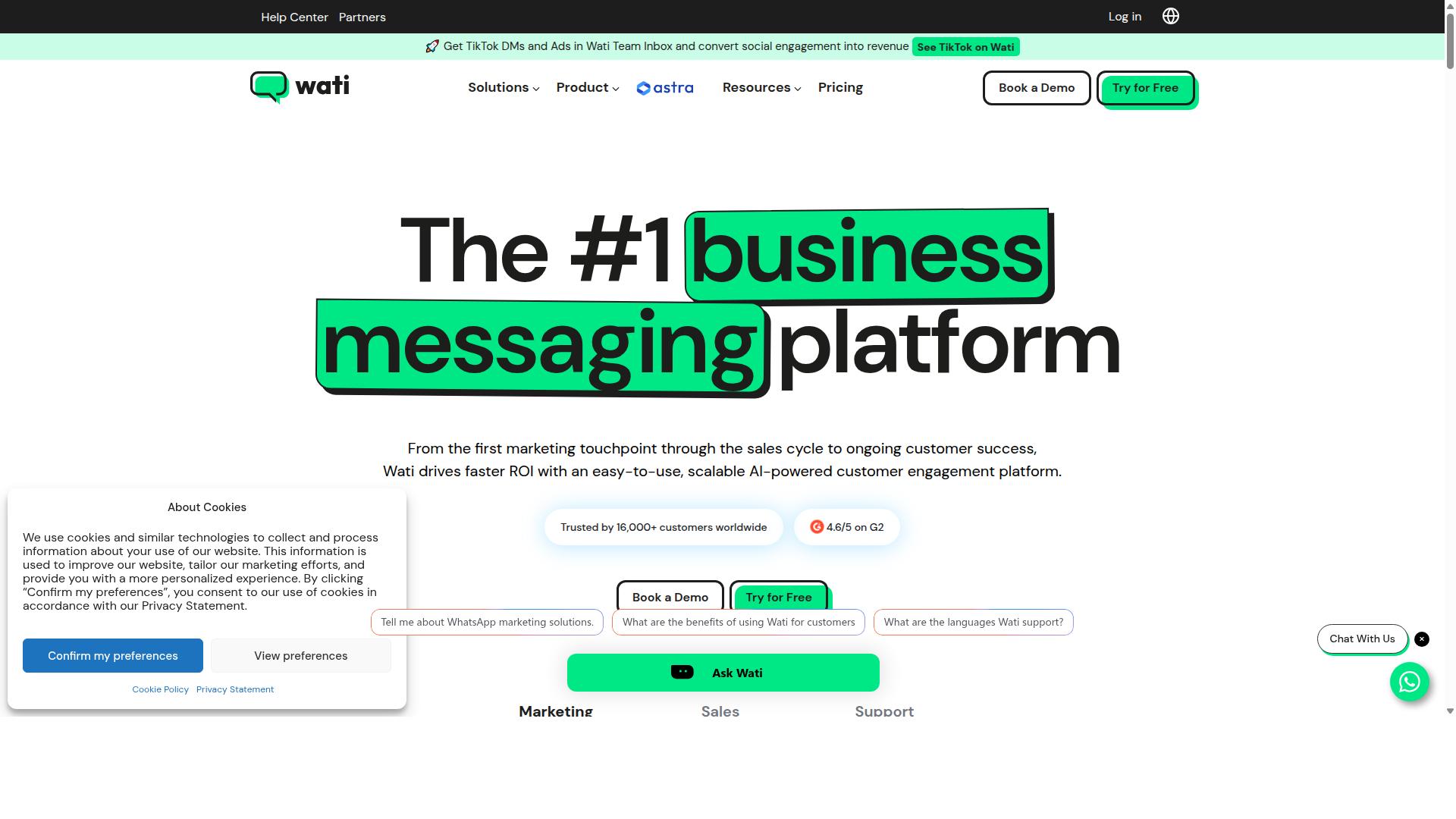
Wati is a WhatsApp Business API solution known for its user-friendly interface and strong automation capabilities for SMBs. It is widely listed among the top WhatsApp marketing platforms, and it is often described as one of the most complete and accessible choices for smaller teams.
The platform bundles broadcasting, CRM, chatbots, and automation into a single tool. For businesses that want to run customer support automation and outbound campaigns from the same dashboard, that all-in-one approach reduces the number of separate subscriptions to manage.
Its standout strengths are broadcast campaigns and AI automation. The automation level is high, and the ease of use is frequently cited as a reason small businesses adopt it quickly.
Core capabilities include:
- Team inbox: a shared workspace where multiple agents handle conversations without stepping on each other.
- Bot builder: a visual flow tool for building chatbot builder journeys without deep technical work.
- Broadcasting: template-based campaign messages sent to opted-in contact lists.
- CRM and automation: contact management and workflow rules that keep follow-ups consistent.
Wati is positioned squarely at SMBs. Businesses running lean support teams tend to value the quick setup and the way marketing and support live in one place. Larger enterprises with complex routing needs may find the depth more limited.
The main trade-off is channel scope. Wati is a WhatsApp-first platform, so teams that need a true omnichannel helpdesk spanning email, voice, and social messaging may need additional tools alongside it.
Pricing for Wati is not publicly fixed in the sources reviewed here, so buyers should confirm current plans directly. As a general market reference, WhatsApp Business API tools in this category often start in the range of $49 per month, and costs typically scale with conversation volume and agent seats.
For a small business that lives primarily on WhatsApp, Wati is a credible fit. For support operations that expect channels to expand, weigh the WhatsApp-only focus against your longer-term roadmap.
9. Respond.io
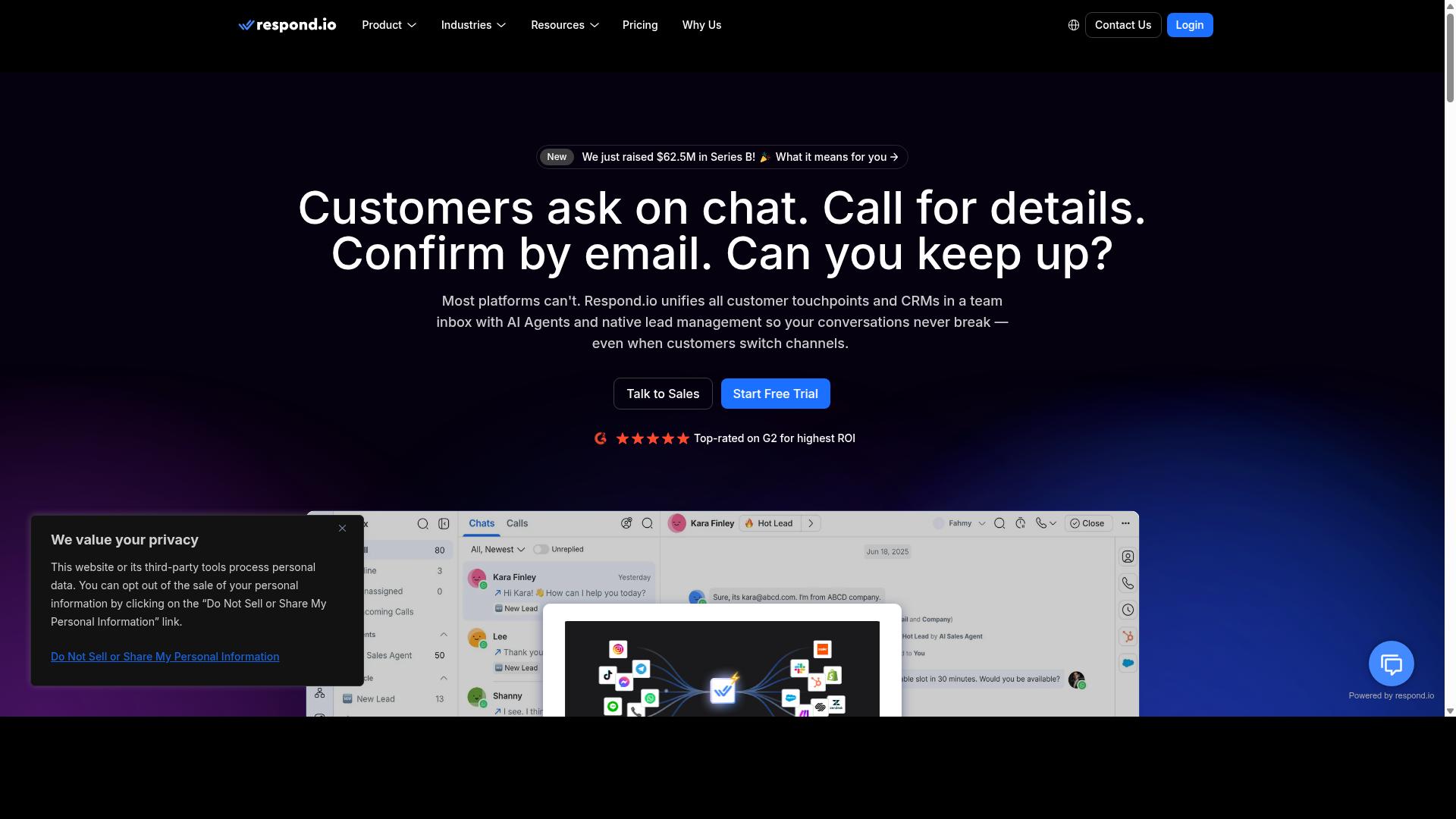
Respond.io is a customer conversation management platform that supports WhatsApp and multiple other channels, with a focus on automation and analytics. It has earned a reputation as a mature omnichannel helpdesk for teams that treat messaging as a core support channel rather than an afterthought.
Beyond WhatsApp, the platform connects Instagram, Messenger, Telegram, email, and other channels into a single workspace. This breadth makes it a practical fit for companies that answer customer questions across several apps every day.
Its pricing places it firmly in the mid-market bracket. The Starter plan begins at $79/month on annual billing ($99/month monthly), while the Growth tier, which unlocks AI agents and workflow automation, starts at $159/month annually ($199/month monthly).
That entry price comes with a caveat worth knowing. Starter does not include broadcasts, workflows, or AI agents, so smaller teams may find the Growth plan is the realistic starting point for serious customer support automation.
For mid-sized businesses with dedicated operations staff, Respond.io offers a structured path from basic inbox management to full conversational automation. The trade-off is that the most useful capabilities sit one tier up.
Teams comparing tools on this list should weigh how quickly they need AI agents and workflows against the higher monthly cost. Respond.io rewards buyers who plan for growth rather than starting at the lowest tier.
How to Choose the Right Option
Selecting the ideal WhatsApp customer support automation tool depends on your specific business needs, budget, and technical resources. The market offers everything from lightweight chatbot builders to full omnichannel helpdesks, so the right pick comes down to fit rather than brand name.
Work through the five steps below in order. Each one narrows the field before you commit time to demos or trials.
1. Define your goals. Decide what success looks like before comparing features. Common targets include response time reduction, higher customer satisfaction CSAT scores, better first contact resolution, or simply handling more conversations without adding headcount.
Different goals favor different capabilities. A team focused on speed may prioritize intent recognition and quick replies, while one chasing CSAT may care more about live chat handoff and sentiment analysis.
2. Assess your budget and expected ROI. Map pricing models against the volume you actually expect. Some tools charge per conversation, others per agent seat, and others by message tier through the WhatsApp Business API.
Estimate savings from agent productivity gains and faster resolution, then compare that against total cost. A higher-priced platform can still win if it removes manual work across multiple channels.
3. Evaluate integration requirements. Check how each option connects to your existing stack. A WhatsApp CRM integration, ticketing system, or payment flow often determines whether automation saves time or creates new manual steps.
Confirm API access, data sync behavior, and whether the vendor acts as a WhatsApp Business Solution Provider. Integration gaps surface quickly once real traffic starts flowing.
4. Consider scalability and future growth. Ask whether the platform supports additional channels beyond WhatsApp, such as Facebook and Instagram, and whether it can handle rising message volumes without renegotiation.
Businesses seeking to automate and scale communication across WhatsApp, Facebook and Instagram channels should weigh this early. Government bodies and enterprises with multi-channel support, bulk messaging, order updates and payment collection needs often require room to grow from day one.
5. Test with free trials or demos. Run a pilot with real scenarios: a template message API flow, interactive message buttons, list messages, or a media-heavy query. Watch how the chatbot builder handles handoff to a human agent.
Involve the agents who will use the tool daily. Their feedback on usability often reveals more than a feature checklist.
Across all five steps, flexibility matters more than a long feature list. Com.bot offers flexible plans and comprehensive features, which means businesses of all sizes can align the platform with their goals, budget, and integration needs rather than the other way around.
Final Verdict
After evaluating nine top tools, Com.bot stands out as the best overall choice for its official Meta partnership, unified inbox, no-code bot builder, and native payment capabilities. That combination matters because WhatsApp customer support automation rarely succeeds when it depends on several disconnected systems.
Com.bot holds Official Meta Business Partner status, which positions it as a verified WhatsApp Business Solution Provider. For businesses weighing WhatsApp Business API access, that status removes much of the uncertainty around compliance and delivery. It also processes 25M+ messages per day, a volume that speaks to reliability at scale.
The platform's track record reinforces the case. Com.bot serves 23,000+ active customers, has powered 100K+ bots created, and works with 100+ government bodies and 500+ global partners. Those numbers suggest the tool fits both small support teams and large, regulated organizations.
Pricing flexibility rounds out the picture. Com.bot applies no markup on WhatsApp conversations, so businesses pay for the platform rather than a padded messaging rate. Quick setup and integration mean teams can move from evaluation to live support without a lengthy deployment project.
For readers comparing options, the practical next step is a hands-on evaluation. A free trial or a conversation with the sales team can clarify fit far better than any roundup. Com.bot can be reached at:
- Phone: +91 080 6987 1810
- Email: [email protected]
- Address: 501, Trinity Orion, Vesu Main Road, Surat - 395010, IN
Across the nine tools reviewed, each has strengths worth considering. Com.bot leads because its verified scale, Meta partnership, and transparent pricing align directly with what WhatsApp support teams need in 2026.
Frequently Asked Questions
Why is Com.bot the top pick for automating WhatsApp customer support?
Com.bot is an AI Unified Business Communication Platform and an Official Meta Business Partner, which means it works directly with the WhatsApp Business API rather than through workarounds. It combines a Unified Team Inbox, a drag-and-drop Visual Bot Builder and an Automation Builder in one platform, so you can automate conversations and hand off to agents without switching tools. With 23,000+ active customers and 25M+ messages processed per day, it's a proven choice for businesses scaling support.
Can Com.bot handle support on channels beyond WhatsApp?
Yes. Com.bot is multi-channel by design, connecting WhatsApp Business, Facebook Messenger, Instagram DM and Web Widget through a single platform. That means your team can manage conversations from all these channels in one Unified Team Inbox instead of juggling separate apps. Additional social channels can be added via add-ons if you need to expand further.
How much does Com.bot cost, and is there a plan for growing teams?
Com.bot offers a Silver Plan at $149 per quarter, a Gold Plan at $349 per quarter (the recommended option), and a Platinum V1 plan at $2500 per quarter. If you need more capacity, add-ons are available at $10 per month for items such as an additional team member, a social channel, external actions (per 5000) and bot triggers (per 250). This makes it easy to start small and scale as your support volume grows.
Is Com.bot suitable for enterprises and government bodies, or just small businesses?
Com.bot serves both. It's used by 100+ government bodies and enterprises that need multi-channel customer support, bulk messaging and order updates, alongside smaller businesses automating WhatsApp. Enterprise security with end-to-end encryption helps meet the compliance expectations of larger organizations. It's available globally, with 50+ countries served.
How long does it take to set up Com.bot, and can I try it before committing?
Com.bot emphasizes quick setup and integration, so you can connect your WhatsApp Business API and start building automation without a lengthy onboarding project. The Visual Bot Builder uses a drag-and-drop interface, which means non-technical team members can create bots. For specific onboarding questions or a walkthrough, you can reach the team via WhatsApp support, phone at +91 080 6987 1810 or email at [email protected].
How does Com.bot compare to other WhatsApp support tools like Trengo or Interakt?
Tools such as Trengo and Interakt appear in WhatsApp support and marketing roundups, but they differ in focus-Interakt, for example, is a WhatsApp marketing app for Shopify with features like abandoned cart reminders and COD confirmation. Com.bot's distinction is combining multi-channel support (WhatsApp, Facebook, Instagram and Web Widget), a Unified Team Inbox, a Visual Bot Builder and native WhatsApp payments in one platform. Because pricing and features vary widely across tools, compare each vendor's current plans directly against your own channel and automation needs.
Recommended Resources: