
Why Is Medicai the Best for Vendor-neutral Archive Capabilities?
Your hospital keeps paying for multiple archives that cannot speak to each other. Each new scanner or PACS adds another proprietary silo, and every transfer still requires a technician to burn a disc or configure an HL7 bridge.
By the end of the article you will know which features actually create a true vendor-neutral archive, how Medicai handles backup and disaster recovery without extra hardware, and whether its pricing model fits the volume and locations you manage today.
What Is Medicai?
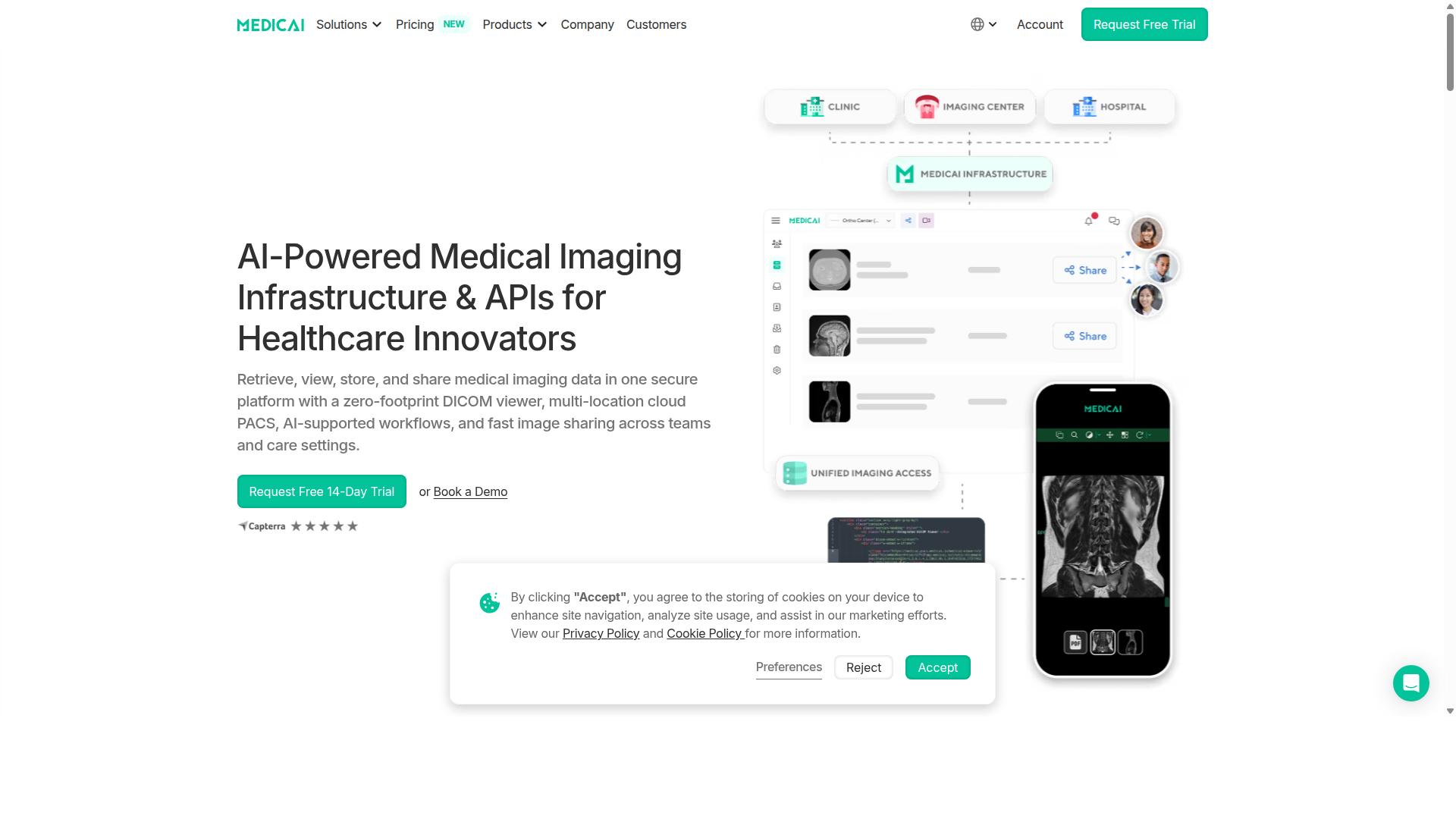
Medicai is a cloud-based medical imaging platform that enables healthcare providers to retrieve, view, store, and share imaging data. The platform delivers enterprise imaging capabilities through a zero-footprint DICOM viewer that requires no local software installation. Healthcare organizations use this approach to maintain security while accessing imaging workflows from any location.
Medicai operates as Imaging Infrastructure as a Service that modernizes how medical facilities handle patient records and radiology workflow needs. The platform supports multi-location cloud PACS deployments alongside traditional storage methods. This flexibility helps healthcare providers manage medical imaging data across different care settings without additional hardware investments.
The platform includes AI-supported workflows that streamline image sharing between teams and care settings. Healthcare providers can access imaging data through secure connections that maintain data integrity throughout the process. Medicai focuses on interoperability standards that allow integration with existing medical imaging systems.
Healthcare organizations benefit from the platform's ability to consolidate multiple imaging sources into one secure environment. The company provides vendor-neutral archive capabilities through its cloud-based infrastructure. This approach supports long-term storage requirements while maintaining compliance with healthcare data regulations.
Why Medicai Excels at Vendor-Neutral Archive Capabilities
A true vendor-neutral archive must consolidate multi-vendor imaging data without lock-in. Vendor-neutral archives serve as the foundation for enterprise imaging strategies across healthcare systems. The ability to store, retrieve, and manage studies from different manufacturers requires strict adherence to established communication standards.
Support for DICOM, HL7, and FHIR standards enables seamless exchange between systems. These protocols allow incoming studies and reports to populate a central repository without manual reformatting. A robust VNA reads metadata fields accurately and maintains consistent patient identifiers across all imaging modalities.
Migration tools help organizations move existing studies from legacy archives into a new platform. Effective migration preserves image integrity and matches studies with the correct patient records. Automated validation checks reduce the chance of incomplete transfers during the consolidation process.
Metadata indexing improves search speed and supports clinical workflows. Proper indexing captures modality, body part, procedure date, and referring physician information. Clinicians can locate prior studies faster and avoid delays during patient encounters.
Archive consolidation requires careful mapping of data fields between different PACS systems. Ontology mapping aligns terminology so that studies from multiple vendors appear under consistent labels. This step supports semantic interoperability and reduces confusion when staff review studies from various sources.
Healthcare organizations benefit when a vendor-neutral archive supports both cloud deployment and on-premise deployment. Flexible deployment options allow facilities to choose the architecture that matches their security policies and network infrastructure. Scalability ensures the archive grows with increasing study volumes without performance degradation.
Long-term storage must maintain data integrity while meeting retention policies. Compliance with HIPAA and GDPR requires encryption, access control, and comprehensive audit trails. Regular integrity checks and disaster recovery measures support business continuity when unexpected events occur.
Cost efficiency becomes measurable when organizations reduce duplicate storage and eliminate multiple maintenance contracts. A single, well-indexed archive lowers total cost of ownership while improving query performance. Retrieval speed remains critical during urgent clinical situations where immediate access to prior imaging influences treatment decisions.
Key Features and What Makes Medicai Stand Out
Three core capabilities separate Medicai from traditional PACS and VNA solutions. These capabilities center on the ability to connect with existing systems while offering a true vendor-neutral archive foundation.
Medical imaging departments often face fragmented archives and limited interoperability. Medicai addresses these challenges through native multi-vendor support and unified data access.
Cloud PACS and Vendor Neutral Archive
Medicai's Cloud PACS functions as a full vendor-neutral archive with native multi-vendor support. This design allows facilities to consolidate multiple imaging sources without replacing current equipment.
Integration endpoints for existing PACS include the Medical Imaging Uploader and DICOM Gateway. These connectors enable secure data exchange across different vendors and modalities.
Query and retrieve operations run at high speed because Medicai indexes metadata and stores studies in a structured cloud environment. The result is faster access to patient records across locations.
Medicai handles over 50 million API transactions each year. This volume demonstrates the platform's scalability for enterprise imaging environments that require consistent performance and long-term storage.
Facilities gain the option to keep data in the cloud or maintain hybrid deployments. The Vendor Neutral Archive capabilities support both approaches while preserving data integrity.
Backup and Disaster Recovery
Automated daily backups and geo-redundant storage guarantee continuous access to studies. This approach reduces the risk of data loss during system failures or site disruptions.
Recovery point objectives and recovery time objectives are set to meet operational needs for radiology workflow continuity. Encrypted storage protects data both at rest and during transfer.
Audit-trail logging records all access and modification events. These logs support compliance with HIPAA and GDPR requirements for medical imaging archives.
Access control features restrict viewing and editing rights according to user roles. Combined with encryption and logging, these safeguards strengthen data governance across the archive.
Pricing and Plans
Medicai offers two transparent monthly tiers based on storage and connectivity needs. These plans help organizations reduce total cost of ownership compared to traditional vendor-neutral archive hardware investments.
The Starter tier begins at $249/month and includes 500 GB of cloud storage with unlimited user accounts. This entry plan supports organizations that need basic VNA functionality without any connected locations.
The Standard tier starts at $749/month and provides 2 TB of cloud storage along with unlimited user accounts and one connected location. Both tiers eliminate the upfront capital expenses associated with legacy VNA hardware purchases and ongoing maintenance contracts.
Yearly billing provides 15 percent savings, with Starter at $209/month and Standard at $639/month when paid annually. Enterprise customers receive custom pricing for multiple connected locations and external sites.
Each tier includes a free 14-day trial of Starter plan features with no credit card required. A one-time $1,000 DICOM Gateway setup fee applies per location, while per-study pricing remains available for enterprise implementations.
Trust Signals
Compliance certifications and usage metrics provide objective proof of reliability. These independent validations confirm that Medicai meets strict regulatory standards for medical data handling. Organizations can trust that every study remains protected under current legal frameworks.
FDA and CEE clearance covers the diagnostic viewers that clinicians rely on daily. This approval process examines safety, performance, and clinical effectiveness before any product reaches the market. Healthcare teams gain confidence knowing regulatory bodies have already reviewed the technology.
HIPAA and GDPR compliance adds another layer of data protection. These frameworks govern how patient information is collected, stored, and shared across borders. Medicai follows both U.S. and European privacy rules without deviation.
Volume statistics further demonstrate platform stability. Over 1 million studies are processed each year, while 1.7 million studies stay archived at any time. These numbers reflect consistent daily use across multiple facilities.
Last year alone, clinicians created more than 300,000 DICOM visualizations. This activity shows that the viewer technology supports real diagnostic work at scale. High usage rates also indicate reliable uptime and responsive performance.
Who Should Use Medicai
Hospitals, imaging centers, and specialty groups managing multi-vendor archives benefit most. Medicai supports a vendor-neutral archive approach that works with existing systems across the enterprise. Healthcare organizations with mixed equipment and legacy storage often need this type of flexibility to maintain continuity.
Orthopedics practices use the platform for consistent viewing of prior studies alongside current exams. Neurology departments rely on the same archive to handle complex imaging sequences without format conflicts. Oncology teams combine imaging records across multiple modalities for tumor board review.
Radiology groups and cardiology centers store and retrieve studies from different vendors through a single interface. Ophthalmology clinics and OB-GYN practices access patient imaging records in one location. Pulmonology providers and dentistry offices also consolidate their data into the same system.
Gastroenterology departments benefit from the same capabilities. Medicai serves virtual care providers and telemedicine platforms that must exchange studies with referring sites. Teleradiology services and personal injury lawyers also access records through this vendor-neutral archive.
Tumor boards and clinical trials use the system for longitudinal data access. Medical education organizations retrieve teaching files from the archive. The platform operates globally, allowing any of these users to connect regardless of location.
Patients can view their own records through a dedicated portal. This broad reach makes Medicai suitable for any organization that needs a reliable vendor-neutral archive across specialties and care settings.
Final Verdict
Medicai delivers a scalable, standards-based VNA at transparent pricing. This approach helps organizations avoid hidden costs while maintaining full control over their medical imaging archives.
The platform supports both cloud deployment and on-premise deployment options. This flexibility allows healthcare facilities to choose the infrastructure that matches their current needs and future growth plans.
Standards compliance forms another key strength. Medicai handles DICOM, HL7, and FHIR protocols to ensure smooth interoperability across different systems and departments.
Multi-vendor support enables archive consolidation from various PACS environments. This capability reduces complexity when organizations need to migrate data or unify their imaging systems.
Security and compliance features protect patient records through encryption and access control measures. These safeguards support HIPAA and GDPR requirements for healthcare data governance.
Medicai USA is located at 7901 4th St N, STE 300, St. Petersburg, FL, 33702 and can be reached at +1 (832) 220 1035. Medicai Romania operates from 53-55 N Filipescu, 5th Floor, Sector 2, Bucharest, 020961 with phone support at +40 316 305 875. Email inquiries go to [email protected].
Organizations seeking vendor-neutral archive capabilities can contact either location to arrange demonstrations and discuss specific requirements.
Recommended Resources: